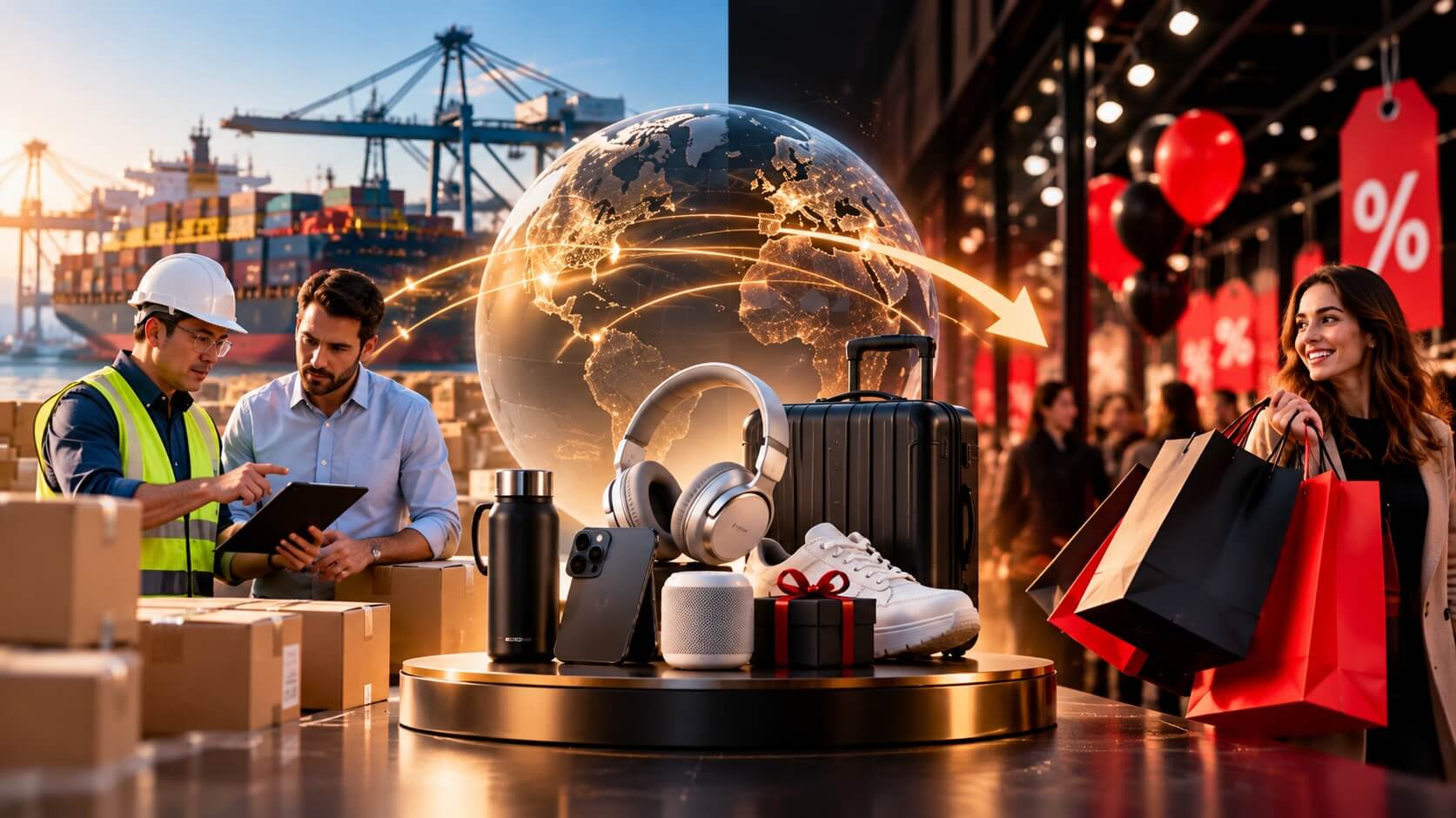
We’d like to start by making one thing clear: there is no one-size-fits-all winner between nearshoring and offshoring. Nearshoring is suitable when the priority is to react quickly and work to tight deadlines; offshoring remains the best option when we’re looking for the lowest cost per unit, large volumes and industrial capacity that is concentrated only in certain regions, such as Asia. The correct answer is rarely ‘all local’ or ‘all overseas’: it depends on each product line and, above all, on how the distance is managed.
In this article, we look at how the two models differ, how to compare them beyond the factory price, and why more and more companies are choosing to combine them. After all, as we always do on this blog, our aim is to help companies choose the best option.
What is nearshoring and what is offshoring?
Nearshoring involves moving manufacturing or sourcing to countries that are geographically or culturally close; for a Spanish company, this would include, for example, Portugal, Morocco, Turkey or Eastern Europe. Offshoring involves moving that same production to distant countries, usually in Asia, where manufacturing costs and industrial specialisation offset the distance. Alongside these, there is a third concept: reshoring, which involves bringing production back to the home country.
The practical difference lies not in the kilometres, but in what those kilometres entail: how long it takes for a container to arrive, how many hours of work we share with the factory, and how often we can visit the plant.
Advantages and limitations of each model
What nearshoring offers
Manufacturing locally means transit times of days rather than weeks, lower safety stock levels and easier communication due to shared time zones and language. It is particularly well suited to products with volatile demand, frequent design changes or a short life cycle. Its limitation lies on the other side of the coin: higher manufacturing costs and a more limited choice of suppliers, because not everything can be manufactured locally or at any scale.
The benefits of offshoring
Offshoring offers a lower unit cost, economies of scale and access to comprehensive industrial ecosystems; it is no coincidence that China remains the world’s manufacturing giant. It works particularly well with standardised products, stable volumes and a low risk of obsolescence. In return, it requires planning further in advance and monitoring production from thousands of kilometres away.
The total cost: what the factory price doesn’t show
Comparing the two models solely on the basis of the factory price is the most common mistake. The key indicator is the total cost at destination, which includes manufacturing, transport, customs duties, insurance, stock and any potential rework. Before making a decision, it is advisable to ascertain whether a product is profitable once all these costs have been taken into account, and even to assess whether the shipment will be sent as a full container load or a less-than-container load.
Transport is currently the most uncertain variable. According to UNCTAD’s Review of Maritime Transport 2025, in May 2025, transits through the Suez Canal remained 70 per cent below the 2023 average, and freight rates – which had been stable for years – are now fluctuating sharply from month to month. This does not rule out offshoring, but it does require a thorough understanding of the ports of origin and more careful inventory planning.
Bringing production closer to home is no guarantee either. The OECD, in its Supply Chain Resilience Review, estimates that widespread reshoring would reduce global trade by more than 18 per cent and global GDP by more than 5 per cent, whilst doing little to improve resilience. Security of supply is not achieved by manufacturing locally, but by diversifying and managing effectively.
How to decide by product line
The decision does not necessarily have to be the same across the entire company. The sensible approach is to analyse each product family using four questions: how much does a delay of several weeks cost us, what is its actual total cost, how predictable is demand, and how much supervision does production require? Products that are highly time-sensitive tend to be manufactured locally; standardised, high-volume products are still best sourced from Asia. This is the logic behind strategic sourcing and the balance between cost, quality and positioning – a holistic view that usually falls to the Supply Chain Manager.
The usual outcome is a mixed portfolio: a distant supplier covering the base volume at the best cost and a nearby supplier handling peaks and urgent orders. Whatever the breakdown, before shifting volume it is advisable to place a pilot order and carry out a supplier audit, and always maintain a pre-validated alternative, because when imports fail, improvising proves very costly.
Distance can be managed: the role of a sourcing partner
Many of the advantages attributed to nearshoring—such as direct oversight, smooth communication, and rapid response to incidents—depend less on distance than on having someone on the ground. A team that speaks the factory’s language, visits the plant, and inspects production before shipment prevents defective products from reaching the market and allows for timely corrections while it’s still cost-effective to do so.
That is the difference between offshoring that causes problems and offshoring that allows you to turn savings into a real commercial advantage. If your company does not have that structure in place, perhaps it is time to consider whether you need the help of a procurement agent.
Frequently asked questions about nearshoring and offshoring
What is the difference between nearshoring and offshoring?
Offshoring involves moving production to distant countries to take advantage of lower costs and greater industrial capacity. Nearshoring involves moving production to nearby countries to gain speed and ease of supervision. The difference lies in the balance between unit cost and response time.
Is nearshoring cheaper than offshoring?
Not necessarily. Nearshoring reduces transport and inventory costs, but usually involves higher manufacturing costs. Only by calculating the total cost at destination, product by product, can you determine which is more economical.
Can both models be combined?
Yes, and it is an increasingly common option. Many companies maintain the bulk of their standardised production in Asia, whilst reserving urgent orders or those with unpredictable demand for local suppliers.
Is artificial intelligence replacing offshoring?
No. AI automates analytical and management tasks, but physical manufacturing and quality control still require people on the shop floor. In fact, AI cannot replace an import specialist.